
- By Ashwani Kumar
- Sun, 05 Apr 2026 10:21 AM (IST)
- Source:JND
The Iran war defies hope for an early de-escalation despite conflicting reports of back channel diplomacy to end hostilities. The theatre of conflict now extends to the Gulf States with Iranians attacking the US military assets in the region. Iran's blockade of the Strait of Hormuz could see the entry of NATO members in the conflict.
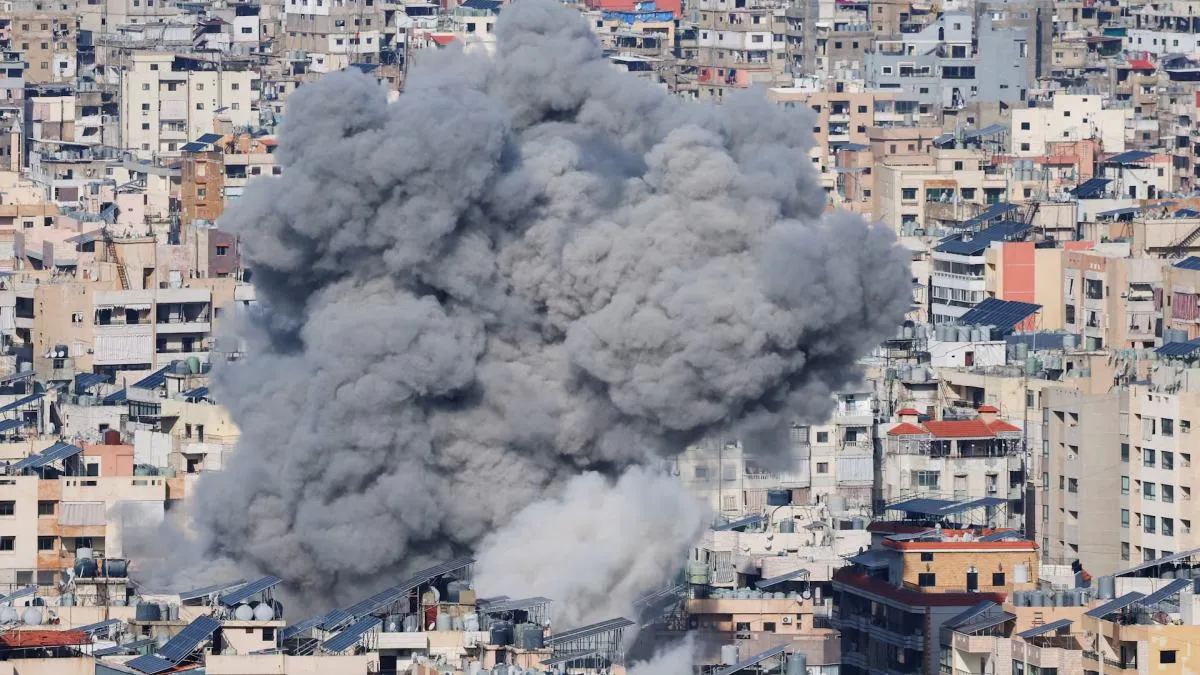
The war is a colossal tragedy that has extinguished thousands of innocent lives since February 28, reduced to rubble large human habitations, caused the largest ever disruption of the global oil and gas, and financial markets. Presented to the world as a preemptive strike in self defence by the US and Israel against Iran's apprehended nuclear adventurism, and necessary for a regime change in support of freedom and human rights of the Iranian people, the war has few takers for its moral and legal legitimacy. The catastrophic war is widely seen as a hegemonic exercise of raw power for dominion over people and energy resources. It is a tragic confirmation of the impotence of the post 1945 international legal order to prevent wars and preserve peace when confronted with the audacity of hard power and its hegemonist exercise. The Venezuelan adventure of Trump and his tariff wars attest the collapse of what remains of the architecture of international law helmed by the UN Charter and the International humanitarian law codified in the Geneva conventions and other treaties.
ALSO READ: Gulf In Turmoil: Why Iran War Is A Shared Crisis For South Asia | Opinion
President Trump's statement that Iran's ballistic missile capabilities stood obliterated after the Israeli kinetic attacks of June 25 is a clinching denouement of the proffered logic of the war. The coordinated US-Israeli attack on Iran without authorisation of the UN Security Council or prior approval by the US Congress and in breach of the War Powers Resolution of 1973, has robbed the war of even a modicum of legal justification. The assassination of Iran's political leaders and the scale of military strikes on civilian targets inside Iran violate the fundamental principles of "distinction, proportionality, military necessity and precaution". No concrete evidence of the apprehended nuclear strike by Iran against the United States or Israel has been presented despite repeated queries by several prominent leaders of the global south.
The regime change justification cited both by Israel and the United States for the use of force against Iran militates against the first principles of international law founded in the inviolability of territorial integrity and sovereignty of nation states. The Opinion of Judge Hardy Dillard of the International Court of Justice in the Western Sahara case reminded us as far back as 1975, that "it is for the people to determine the destiny of the territory and not the territory the destiny of the people". To accept, even remotely, the validity of the spurious regime change argument for waging war against a sovereign nation would need a rewriting of the UN Charter and the rules of war, even as mass atrocities and killings in Iran may be justly condemned as an affront to the collective consciousness of the international community.
Recent conflicts across the world in Ukraine, Gaza, Venezuela and Iran and the global tariff wars unleashed by the United States compel a philosophical encounter with the reality and nature of power. The perceived indifference of political leadership on the global high table to human suffering signal a reversal of civilisational progress - a "protracted widespread retrogression" of a world that must continue to aspire for civilising itself in the use of force. But, even as we bemoan the decline, if not the demise of international law as a guarantee of universal peace, we can draw comfort in the thought that "you can bomb the world into pieces, but you cannot bomb it into peace". We know from history that war is itself the problem and not a solution to the inequities of our world and injustice in any form carries within itself the seeds of revolution. We also know that unless free of the dehumanising ravages of war, the realisation of a humane world order will remain an illusion.
ALSO READ: Jagran Opinion: Who Is Winning The Iran War
Prime Minister Modi's repeated exhortations for peace and de-escalation signal a clear disapproval of armed hostilities and the urgency to ensure a mediated settlement of the conflict. This is consistent with India's promotion of peaceful co-existence among nations and the eschewing of war as an instrument of conflict resolution. A necessary corollary of this nuanced approach would be to ensure adherence to a stricter international legal regime as a guardrail against the imperial exercise of power. This is premised upon a binding commitment to the substance and processes of international law on the part of those who hold the levers of power to sustain global justice anchored in international law and morality. India's role at this critical juncture must be of a peace maker in the best traditions of its foreign policy anchored in our ancient philosophy of Vasudhaiva Kutumbhakam and Nehruvian internationalism.
However, to be heard with respect, our perspective must recognise the realities of a dynamic power calculus and compulsions of geopolitics in furtherance of the nation's overarching priorities. In responding to a constantly evolving situation in a meandering war, the government's judgement on how best to safeguard national interest as the ubiquitous moral imperative, is entitled to deference. While issues relating to the nation's foreign and defence policies are not beyond debate, public discourse on the subject must acknowledge that a serving government alone is best equipped to leverage and harness the factors of national power in the service of domestic goals. Also, it is impolitic to accuse the leader of the government and by necessary implication, a highly competent national foreign policy establishment, of bad faith in the conduct of foreign policy. In any case, a tempered articulation of dissent has greater resonance than accusations laced in vitriol.
Lest we forget, the challenge of diplomacy is to align principle with power in a mutually reinforcing engagement so as not to be pushed to the margins of irrelevance in navigating relations between nations defined by the balance of power. And as we strive to tame hegemonic power to the discipline of law and consciousness of a civilised world, we must ensure that India is not "acquiescent" in unconscionable unilateralism in a world that must recognise the imperatives of multipolarity and multilateralism.
(Note: The author is a Senior Advocate in Supreme Court and former Union Minister for Law and Justice. The views expressed are his own.)