
- By Dr Sadhana Kala
- Mon, 23 Mar 2026 03:46 PM (IST)
- Source:JNM
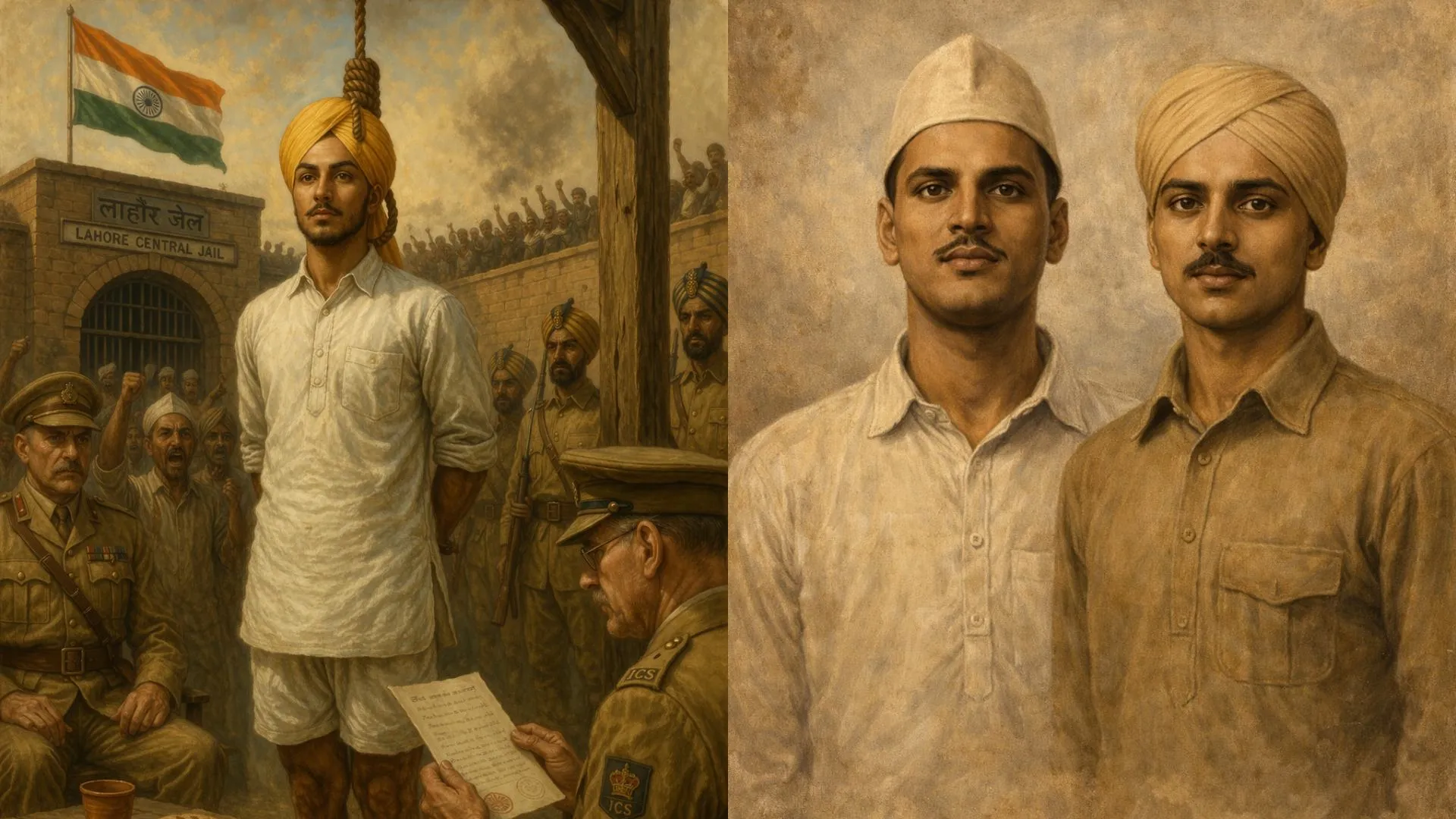
March 23, Martyrs' Day or Shaheed Diwas, marks the execution of three young revolutionaries—Bhagat Singh, Shivaram Rajguru, and Sukhdev Thapar—by the British colonial government in 1931. Their sacrifice did not merely become a chapter in history; it became a living symbol of courage, conviction, and the ongoing fight for freedom.
More than nine decades later, Martyrs’ Day is not just about remembrance—it is about reflection. It compels us to revisit the ideals that fueled India’s freedom struggle and ask ourselves how they resonate in contemporary times.
The Historical Context
A rising tide of resistance against British rule marked the early 20th century in India. While many leaders advocated non-violent resistance, a parallel stream of revolutionary activism emerged, driven by young Indians frustrated with the slow pace of change. Among them, Bhagat Singh stood out—not only for his fearless actions but also for his intellectual depth.
Bhagat Singh, along with Rajguru and Sukhdev, was associated with the Hindustan Socialist Republican Association (HSRA). Their actions were not acts of blind violence but calculated political statements aimed at awakening a nation under subjugation.
The trio became central figures in the assassination of British officer JP Saunders in 1928, an act carried out to avenge the death of Lala Lajpat Rai, who had succumbed to injuries sustained during a protest against the Simon Commission. Later, Bhagat Singh and Batukeshwar Dutt threw non-lethal bombs in the Central Legislative Assembly in Delhi, deliberately courting arrest to use the trial as a platform to broadcast their revolutionary ideology. Their eventual execution on March 23, 1931, turned them into immortal icons of resistance.
Beyond the Gallows: The Ideology of Revolution
To reduce Bhagat Singh and his comrades to mere martyrs would be to overlook the profound intellectual legacy they left behind. Bhagat Singh was an avid reader and thinker who engaged deeply with ideas of socialism, secularism, and anti-imperialism. His writings reveal a young man far ahead of his time, questioning not only colonial oppression but also social inequalities within Indian society.
He famously wrote about the need for a revolution that went beyond political independence—a revolution that would ensure justice, equality, and dignity for all citizens. This broader vision continues to challenge and inspire generations.
Despite receiving less attention in popular discourse, Rajguru and Sukhdev demonstrated equal commitment to the cause. Their courage, discipline, and unwavering belief in the movement underscore the collective nature of India’s freedom struggle.
Martyrs’ Day in Contemporary India
In today’s India, Martyrs’ Day is observed through ceremonies, tributes, and educational programs across schools, colleges, and public institutions. Statues are garlanded, patriotic songs are sung, and speeches are delivered. Nevertheless, the true significance of the day lies beyond ritualistic homage.
The lives of these young revolutionaries offer a grounding perspective in an age dominated by rapid technological change, globalization, and shifting societal values. They remind us of a time when individuals were willing to sacrifice everything—not for personal gain, but for an idea larger than themselves.
Their stories also serve as a counterpoint to the growing culture of instant gratification. Bhagat Singh was just 23 when he was executed, yet his clarity of thought and depth of commitment rival that of seasoned leaders. It raises an important question: what does it mean to be truly committed to a cause in today’s world?
The Youth and the Spirit of Resistance
One of the most enduring aspects of March 23's legacy is its connection to youth. Bhagat Singh, Rajguru, and Sukhdev were all in their early twenties—an age often associated with exploration and uncertainty. However, they displayed remarkable conviction and purpose.
For India’s youth today, their story is both inspiring and challenging. It is inspiring because it demonstrates the power of young voices in shaping history. It is challenging because it establishes a high standard for civic responsibility and moral courage.
In a democratic India, the forms of resistance have changed. The battlefield is no longer colonial rule, but issues such as inequality, corruption, environmental degradation, and social justice. The spirit of questioning authority, standing up for what is right, and working towards collective well-being remains as relevant as ever.
Remembering, Not Romanticising Globalisation
While it is important to honor the sacrifices of these martyrs, it is equally crucial not to romanticize violence. An understanding of revolution, emphasizing the power of ideas over weapons. His actions were rooted in a specific historical context, and his writings suggest a deep belief in rational thought and social transformation, which highlights the importance of understanding the ideological foundations of revolutionary movements rather than merely glorifying their violent aspects.
Remembering Martyrs’ Day should therefore involve engaging with their ideas, not just their actions. It should encourage critical thinking, informed debate, and a commitment to democratic values.
The Role of Media and Public Memory
Media institutions, including platforms such as The Times of India, have a significant impact on public memory. By revisiting stories of the freedom struggle and highlighting lesser-known aspects of these figures, the media can ensure that their legacy remains dynamic and relevant.
In the digital age, storytelling has the power to reach millions instantly. Documentaries, podcasts, social media campaigns, and interactive content can bring history alive for younger audiences. However, this role also comes with the responsibility of accuracy and nuance.
Reducing complex historical figures to simplistic narratives risks diluting their true significance. Bhagat Singh was not just a “freedom fighter”; he was a thinker, a writer, and a visionary. Capturing this complexity is essential to doing justice to his legacy.
A Day of Reflection and Renewal
Ultimately, Martyrs’ Day is not just about looking back—it is about looking inward. It invites us to reflect on the kind of nation we are building and the values we uphold.
Are we fostering a society that aligns with the ideals of justice and equality that these martyrs envisioned? Are we encouraging critical thinking and active citizenship among the youth? Are we willing to stand up against injustice, even when it is inconvenient?
These are not easy questions, but they are necessary ones.
Conclusion
March 23 is more than just a date on the calendar; it is a poignant reminder of the cost of freedom and the responsibilities that come with it. The sacrifices of Bhagat Singh, Rajguru, and Sukhdev were not in vain—they ignited a spark that contributed to India’s eventual independence and will inspire future generations.
As we observe Martyrs’ Day, let us move beyond symbolic gestures and engage with the more profound meaning of their legacy. Let us strive to build an India that reflects the ideals they lived and died for—an India that is just, inclusive, and fearless in the face of adversity.
In remembering them, we do not just honor the past—we shape the future.
(Note: Dr (Prof) Sadhana Kala is a USA-trained robotic & laparoscopic surgeon, Uppsala University, Sweden, trained fertility specialist, Icon Endoscopic Surgeon of North India, and National Icon Endoscopic Surgeon of India. She is rated as India's Best Gynecologist by Google.)
(Disclaimer: The views expressed in this article are the personal opinions of the author.)